Source Class I CE Ambulance Stretcher for ER, Ambulance, and Hospital
Compare 30 class i ce ambulance stretcher options from verified Chinese manufacturers. Buyers can evaluate specifications like load capacity, folding mechanisms, and wheel sizes to find suitable equipment for emergency rooms, ambulances, and hospitals; compare the available evidence and request quotations based on your requirements.
Key considerations
Products List






Comprehensive Sourcing Guide
Class I CE Ambulance Stretcher Sourcing Guide
Class I CE ambulance stretchers are the workhorse patient-transfer platform for emergency medical services, hospital emergency departments, and ambulance conversions, and procurement teams evaluating this category need a disciplined framework for comparing listings that can vary widely in structure, materials, and listed certification claims. A class I designation under the medical device classification regime indicates the lowest risk tier, but it still requires a conformity assessment and a properly assembled technical file, so buyers should treat CE marking as a documented claim to be verified rather than a label to be accepted at face value.
This guide draws on observed product-page attributes from current listings — including foldable aluminum-frame stretchers, wheeled ambulance trolleys with adjustable back sections, and manual-operation transfer stretchers — to help buyers build a verification checklist. Rather than recommending any specific supplier, the sections below define what to confirm before issuing a purchase order: product scope and listing signals, technical specifications, compliance documentation, commercial terms, supplier qualification, and long-term procurement controls. Use it as a template for structured supplier interviews and sample evaluation.
Product Scope and Observed Listing Signals
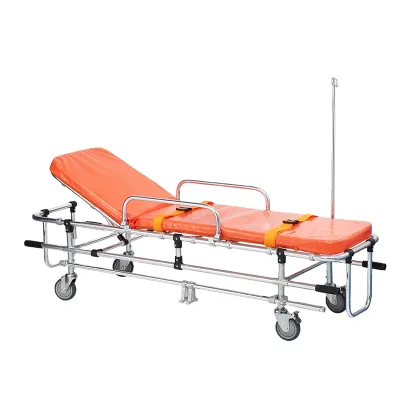
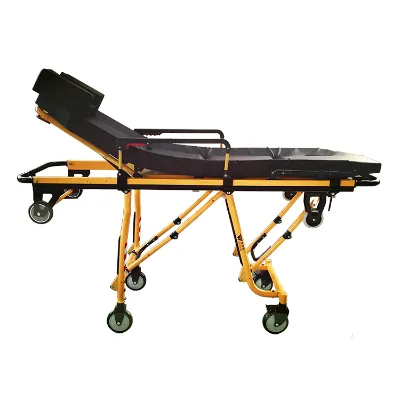
Listings in this category typically include three product families: foldable manual stretchers intended for ambulance stowage and emergency-room use, wheeled ambulance trolleys with height adjustment and backrest articulation for patient transfer, and hybrid designs with collapsible frames plus loading wheels. Observed attributes across current listings include manual operation as the standard operating mode, applicability to hospital emergency rooms and ambulances, foldable or collapsible construction, and mattress-based configurations. Buyers should first decide which family matches their fleet and workflow before comparing individual models.
Listing-level signals offer useful screening data but must be reconciled with supplier confirmations. Observed models carry designations such as HKYL-ZYC-000I, R-EHS-03, YDC-3K03, and NL150502-MDJ02, with origin noted as China and one listing specifically attributing origin to Zhangjiagang, a known cluster for medical furniture and trolleys. Certification text varies between listings — some cite CE, FDA, and ISO together, others CE and ISO, others FDA and ISO/CE — which is precisely why each claim needs documentary backing. Customization and OEM/ODM availability appear on several listings, relevant for fleet-standardization programs.
Technical Specifications to Verify
Structural and dimensional data should be collected in a single comparison table before shortlisting. Observed listings report load-bearing figures from 159 kg to 250 kg, self-weights between 46 kg and 64 kg, and gross packed weights from 60 kg to 78 kg. Unfolded dimensions in the range of roughly 197–205 cm length and 57–62 cm width appear across models, with folded heights as low as 32 cm on collapsible units and low-position heights around 39 cm on trolleys. Verify that folded and unfolded dimensions match your ambulance compartments and stowage bays by physical check, not paper spec alone.
Mobility and adjustment mechanics deserve equal scrutiny. Wheel sizes in the listings range from 150 mm to 200 mm, with one model specifying 5-inch silent wheels — confirm wheel diameter, brake type, and swivel behavior against your floor surfaces and loading-ramp angles. Backrest articulation is listed as 0–75 degrees on some models, and one trolley reports a height adjustment range of 25–92 cm with a 56 cm loading height. Request maximum back-angle verification, confirm strap count (one listing specifies two belts), and ask how each dimension is measured and toleranced in production.
Compliance and Safety Documentation
Because the keyword centers on class I CE status, the documentation review should start with the EU conformity package. Ask each supplier for the Declaration of Conformity identifying the applicable directives and standards, the name and address of the EU authorized representative if the manufacturer is based outside the EEA, and the technical file or its index. Class I non-sterile, non-measuring devices generally allow self-declaration, but the technical file must still demonstrate risk management, design rationale, and biocompatibility or materials evidence for patient-contact surfaces such as the mattress and straps.
Beyond CE, listings cite FDA registration and ISO certification, and buyers importing into regulated markets should independently confirm registration numbers, certificate validity, and issuing-body accreditation rather than trusting listing text. Low-confidence background information such as ISO 13485 quality-management status should be treated as a question to ask, not an assumption. Finally, request the product labeling and instructions-for-use drafts to confirm they include the CE mark, manufacturer details, intended-use statement, load-limit marking, and cleaning instructions, since labeling errors are a common nonconformity in this product class.
Cost Drivers and Commercial Terms
Observed listing prices span an exceptionally wide range, from about USD 14.50 to USD 9,000, which almost certainly reflects a mix of accessories, spare parts, and complete units rather than a uniform product grade; buyers should therefore normalize quotations to a fully specified configuration before comparing. Principal cost drivers include frame material (aluminum is the listed material, lighter but priced differently from steel), wheel specification, mattress type, backrest mechanism complexity, and customization or OEM branding requirements, which several listings explicitly support.
Observed minimum order quantities range from 1 to 200 units, so negotiate MOQ against your fleet replacement schedule — sample or pilot orders at MOQ 1 are feasible with some suppliers, while volume pricing likely requires commitments nearer the top of that range. Packing is listed as wooden box on some models and carton on others; wooden packaging for international freight should include ISPM-compliant treatment documentation, so confirm this in writing. Also agree on Incoterms, payment structure, warranty duration, spare-parts availability, and the treatment of tooling or artwork charges for customized units before contract signature.
Supplier Qualification and Quality Control
Supplier qualification should combine document review with direct process auditing. Beyond the certificates discussed above, ask for a capability statement covering frame welding or joining processes, aluminum finishing, mattress fabrication, and wheel and brake sourcing, since trolley manufacturers typically assemble purchased components. Origin matters for logistics planning — China, and specifically the Zhangjiagang manufacturing cluster, is the listed origin — so confirm the actual production address, not just a sales-office address, and determine whether the factory or a trading company will hold the contract.
Quality control should be anchored in a written inspection plan executed before shipment. Define acceptance criteria for load capacity verification, dimensional checks against the listed specifications (for example, the 200×90×50 cm or 207×60×40 cm packing standards shown on listings, plus unfolded/folded dimensions), backrest angle range, wheel and brake function, and cosmetic finish. Specify the sampling level and whether third-party inspection is permitted. Request pre-production samples for fleet programs, retain a signed golden sample, and require photographic or video inspection records for each batch so recurring defects can be traced to the production lot.
Long-Term Procurement Checks
Sustained fleet performance depends on parts availability and serviceability, so evaluate long-term support at the same rigor as initial price. Confirm which consumable and wear items — wheels, brakes, straps, mattress covers, locking pins — are stocked as spares, their lead times, and whether the supplier commits to supplying parts for a defined number of years after purchase. Listings show customization support and OEM/ODM availability, which is valuable when standardizing a fleet, but changes to specification mid-contract should be controlled through documented change procedures to avoid undocumented variation between batches.
Finally, institute a post-delivery feedback loop. Track in-service failures by component, aggregate incident data from crews, and review it with the supplier at defined intervals; consistent failures in wheels, backrest mechanisms, or folding hinges should trigger corrective-action requests. Re-verify certificates annually, since CE declarations and ISO certificates can lapse or be reissued under different scopes. For multi-year programs, build in periodic requalification audits, refresh the technical file review whenever the supplier announces a design change, and keep a second qualified source identified in case of supply disruption.
FAQs
What certifications do the listed class i ce ambulance stretchers carry?
The listed ambulance stretchers carry CE and ISO certifications, and several listings also indicate FDA certification. Certification can vary between individual models, so buyers should confirm the exact certificates for the specific stretcher model before ordering. Requesting certificate copies during quotation helps verify compliance for hospital emergency room and ambulance use.
How much weight can these ambulance stretchers support?
Load-bearing capacity varies by model in the listings, with observed values ranging from 159 kg to 250 kg. Buyers should match the capacity to their patient transfer requirements and confirm the rated load for the exact model ordered. Heavier-capacity models typically weigh more themselves, so check self-weight and gross weight alongside the load rating.
Can the stretcher height and backrest be adjusted during patient transfer?
Yes, several listed models support adjustment. Observed specifications include a height adjustment range of 25 to 92 cm and a back section panel adjustable from 0 to 75 degrees, with a maximum back angle of 75 degrees. Manual operation is the standard operating mode, so caregivers can reposition patients without external power.
What is the difference between the folded and unfolded stretcher sizes?
One listed model measures 205 by 58 by 93 cm unfolded and 205 by 58 by 32 cm folded, reducing storage height by more than half. Another model lists a high position of 197 by 57 by 90 cm and a low position of 197 by 57 by 39 cm. Check both dimensions against your ambulance storage space before ordering.
What materials and wheels are used on these ambulance stretchers?
Aluminum is the listed construction material, which helps keep self-weight between 46 and 64 kg across models. The stretchers use 5-inch silent wheels, with observed wheel sizes of 150 mm and 200 mm depending on the model. Aluminum frames resist corrosion, which suits frequent cleaning in hospital emergency environments.
Can these stretchers be customized, and how are they packed for shipping?
Customization is supported and available across the listings, and OEM or ODM service is also available for eligible models. Standard packing is a wooden box for some models and carton or carton packing for others. Confirm your preferred packing method and any customization requirements with the supplier before placing an order.